BAREBOAT CHARTER · SPAIN
Chartering a yacht yourself in Spain: the paperwork
A bareboat charter means you take the yacht without a skipper, so the charter company and its insurer want proof that you can handle her. This guide explains the documents they commonly ask for, what each one is, and the simple alternative: a yacht that comes with her skipper.
SHORT ANSWER
One person needs the papers: whoever signs as skipper.
Last reviewed:
To take a yacht in Spain without a skipper, the person in charge must show a boating title that covers the size of the boat and the waters. Spanish law looks first at the title or certificate issued by your own country.
Many charter companies also ask for an ICC, the international document defined by UNECE Resolution No. 40, and some ask for a marine radio operator’s certificate. Every company and insurer sets its own requirements, so get the list in writing.
On a skippered day charter, cruise or sailing week none of this is asked of you. The skipper is aboard and in command, and you can still take the helm.
Bareboat or skippered: who the paperwork is for
Charter comes in two forms. On a bareboat charter you rent the yacht alone and one of your party is her skipper, responsible in law for the boat and for everyone aboard. On a skippered charter the yacht comes with a skipper who carries that responsibility.
Everything in the next five sections applies to the first case. The documents are asked of the person named as skipper on the contract, not of the rest of the crew, although some companies also like to see a second experienced person aboard.
What a charter company in Spain commonly asks for
There is no single national checklist. These are the items that appear most often in Spanish charter contracts for sailing yachts of ten to fifteen metres.
KEY POINTS
- A boating title or certificate of competence issued by your own country, valid for the length of the yacht and the distance from the coast you plan to sail.
- An ICC (International Certificate for Operators of Pleasure Craft) marked for coastal waters and for sail, when your national title is one the company does not know.
- A marine radio operator’s certificate, because the yacht carries a VHF radio with digital selective calling.
- A sailing résumé: the boats you have skippered, where, and how recently. Insurers ask for it more often for larger yachts.
- A passport or national identity card for everyone aboard, for the crew list the company files before departure.
- A security deposit, usually blocked on a credit card in the skipper’s name, or a damage waiver bought in its place.
The ICC, explained as what it is
ICC stands for International Certificate for Operators of Pleasure Craft. Its format and minimum standards are set by Resolution No. 40 of the United Nations Economic Commission for Europe (UNECE), adopted in 1998 so that officials in one country could read a boater’s competence from another.
It is issued by the government of a country that applies the resolution, or by a body that government has appointed, normally to its own nationals and residents. It is issued on the strength of a national title or a test of competence. In other words it is a standard way of showing what you already hold, with categories for inland or coastal waters and for power or sail.
UNECE publishes the list of countries that apply Resolution No. 40, and Spain is not on it. Spanish charter companies ask for the ICC all the same, because it is a document they and their insurers know how to read. Whether it is enough on its own is the company’s decision.
If you hold a boating title, the authority that issued it, or the maritime administration of your country, can tell you how an ICC is issued where you live.
Spanish titles, and what Spanish law says about visitors
Spanish recreational titles are issued by Spain’s maritime administration: the Dirección General de la Marina Mercante, part of the Ministry of Transport, and the autonomous communities that run their own tests. Royal Decree 875/2014 sets them out.
For visitors, the same decree says a Spanish recreational boat may be rented to a person who holds a recreational title or certificate in force, issued by their country of nationality or residence, when that country belongs to the European Economic Area or is listed in the decree’s Annex IX. Holders of a professional seagoing certificate under the STCW Convention may also rent, within the limits of that certificate. The charter company checks your document against these rules, and its insurer may ask for more.
KEY POINTS
- Licencia de navegación: boats up to 6 metres, by day, within 2 nautical miles of a port, marina or place of shelter.
- Patrón para navegación básica (PNB): boats up to 8 metres, within 5 nautical miles of shelter.
- Patrón de embarcaciones de recreo (PER): boats up to 15 metres, within 12 nautical miles of the coast. Extra practical modules add sailing yachts, boats up to 24 metres and the crossing to the Balearics.
- Patrón de yate: boats up to 24 metres, up to 150 nautical miles offshore.
- Capitán de yate: boats up to 24 metres, with no distance limit.
Motor boats and RIBs
The same titles cover motor boats. What changes is the length and power each one allows. For a day on a small motor boat the entry level is the Licencia de navegación: a short practical and shore session in Spain, valid for boats up to 6 metres by day within 2 nautical miles of shelter, and for jet skis.
Since 1 October 2026 the old exemption for small boats applies to private use only. A rented motor boat now needs a skipper who holds at least a Licencia de navegación or a title, whatever its length, including boats of up to 5 metres with engines of up to 15 horsepower. The exemption remains for your own small boat: a motor boat up to 5 metres and 15 horsepower, or a sailing dinghy up to 6 metres, by day and within 2 nautical miles.
Visitors use the title from their own country, exactly as for a yacht. Check that it covers motor boats of the length and power you want to rent, and ask the rental company to confirm by email that it accepts it.
Why you should ask in writing
Two charter companies in the same marina can ask for different documents for the same model of yacht. Each has its own insurer and its own experience of what the local harbour master’s office expects, and the size of the boat, the season and the sailing area all change the answer.
Before you pay a deposit, email the company a scan of the documents you hold and ask three questions. Are these accepted for this yacht and this route? Is a radio operator’s certificate needed? How much is the security deposit? Keep the reply with your booking. It is the only answer that counts on the pontoon.
The simple alternative: a yacht that comes with her skipper
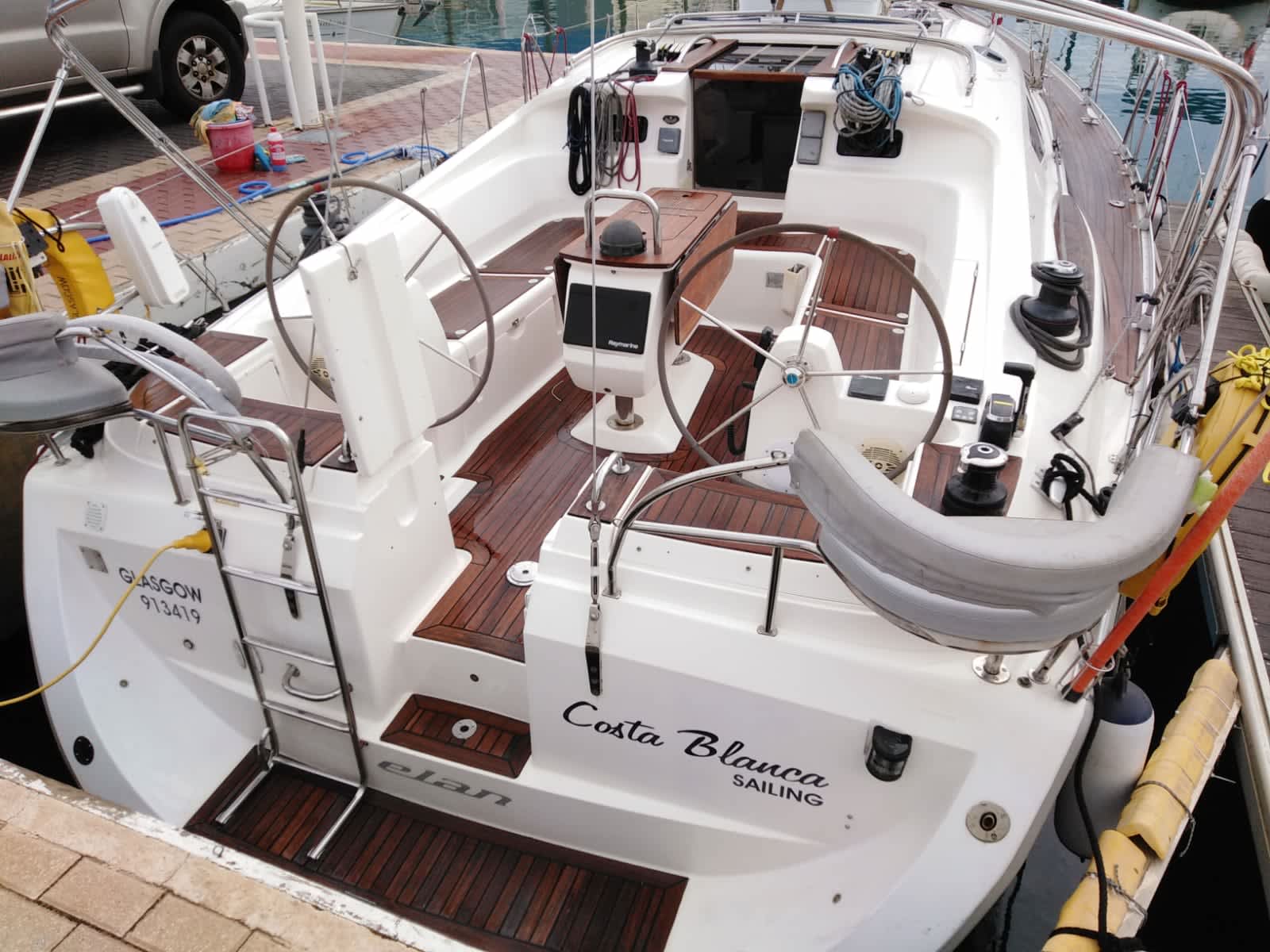
If you would rather spend the holiday sailing than collecting documents, charter a yacht with a skipper. From Marina Alicante our Elan 434 Impression always sails with her skipper, Walter Henderson, who has sailed this coast for more than twenty years. He is in command throughout, so guests bring a passport or identity card and nothing else.
You still sail the boat. Guests steer, trim the sails and handle the lines as much as they like, with the skipper beside them. Taking the helm does not make a guest the skipper, which is exactly what keeps the day relaxed.
KEY POINTS
- Private day charters: €690 for the whole yacht for a half day, €1,190 for the whole yacht for the full day to Tabarca, €2,490 for the whole yacht for two days and one night.
- Small-group cruises: €700 per double cabin per day, minimum four days.
- Sailing weeks: €549 per person for Try Sailing: Two Days Aboard, €995 per person for the five-day Hands-on Sailing Week.
- A 25% deposit holds your dates and the balance is due before you sail.
Common questions
SOURCES
Public sources for the facts on this page, so you can check the detail for your own plans.
- UNECE: International Certificate for Operators of Pleasure Craft (Resolution No. 40)
- BOE: Royal Decree 875/2014 on Spanish recreational boating titles (consolidated text, in Spanish)
- BOE: Royal Decree 1188/2025, the change for rented boats from 1 October 2026 (in Spanish)
- Spanish Ministry of Transport: recreational boating titles, questions and answers (in Spanish)
- Spanish Ministry of Transport: renting a recreational boat (in Spanish)

RATHER LEAVE THE PAPERWORK ASHORE?
Charter the yacht with her skipper.
Tell us your dates and the size of your group. We will suggest a private day charter, a small-group cruise or a sailing week from Marina Alicante, and all you bring is your passport.