MARINE RADIO · ON BOARD
The VHF radio: what you hear aboard, and what it is for
Near the chart table of almost every cruising yacht is a small radio that comes to life a few times an hour. It is how a yacht talks to marinas, to other vessels and to the rescue services, and how the weather reaches her at sea. Here is what guests hear on it along the Costa Blanca, and how a call for help is put together.
SHORT ANSWER
One radio does four jobs: safety, weather, marinas and other vessels.
Last reviewed:
A marine VHF is a short-range radio that every station in range hears at once. A yacht uses it to call for help, to receive weather bulletins and navigation warnings, to speak to marinas and to agree manoeuvres with other vessels.
Channel 16 is the international distress and calling channel. Many marinas, including on this coast, listen on channel 9, and weather bulletins are announced on channel 16 by the coast radio stations and by Salvamento Marítimo, Spain’s sea rescue service.
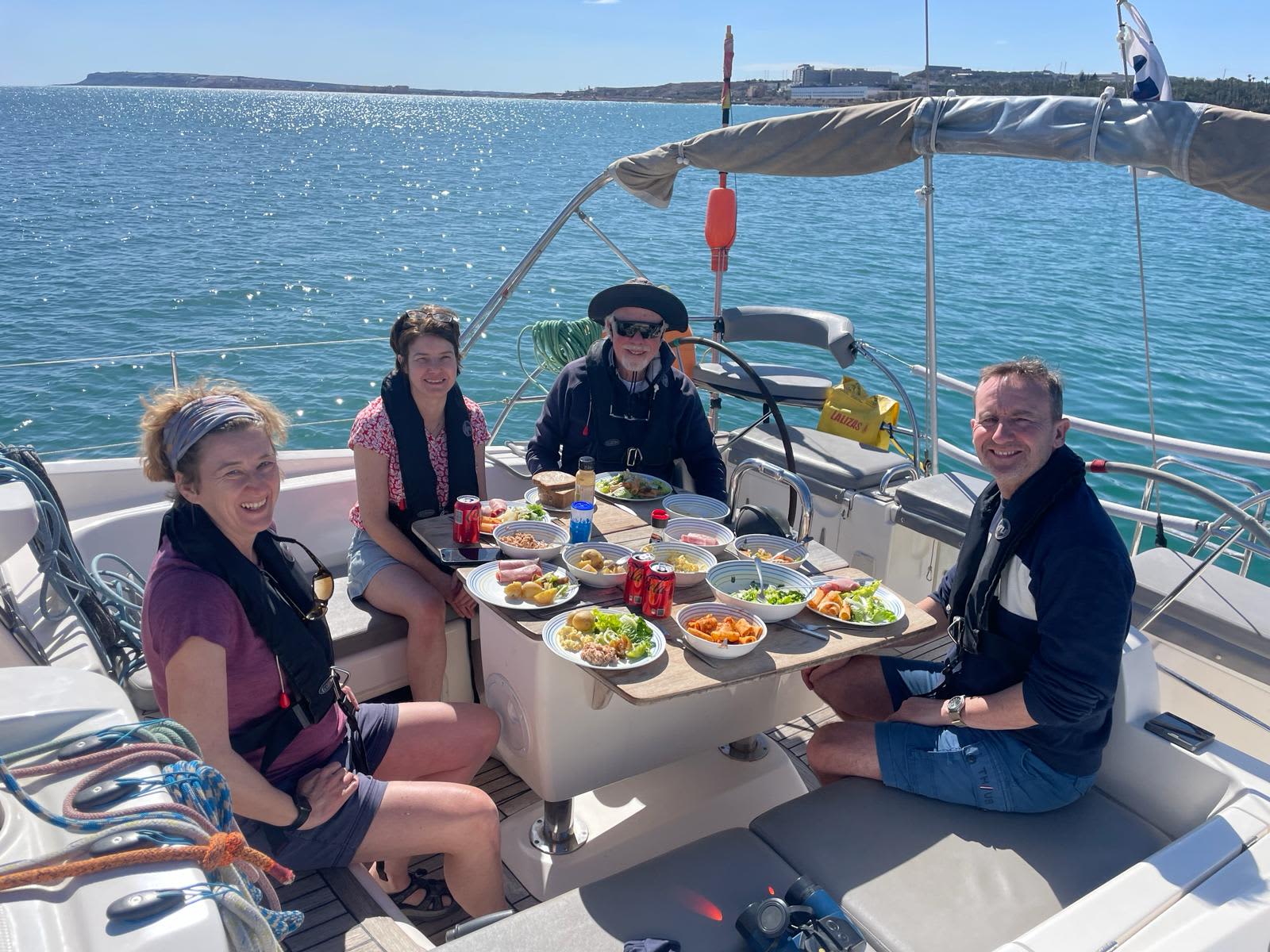
Aboard our yacht the skipper is in command and runs the radio. In the safety briefing every guest is shown where the set is and how to raise the alarm.
What the VHF is for
VHF stands for very high frequency. The signal travels in a straight line from aerial to aerial, so range depends on height: with the aerial at the masthead, a yacht typically reaches a shore station twenty to thirty nautical miles away, and another yacht at rather less. A fixed set transmits at up to 25 watts; a handheld manages five or six, over a much shorter distance.
What makes it better than a telephone at sea is that a call is heard by everyone in range at the same moment: the rescue services, the marina and the fishing boat two miles off. That one quality covers four jobs.
KEY POINTS
- Safety: calling for help, and hearing when another vessel needs it.
- Weather: forecasts and warnings broadcast along the coast.
- Marinas: asking for a berth and for instructions before entering.
- Other vessels: agreeing who passes where with a ferry, a fishing boat or another yacht.
The channels you hear on this coast
Channel 16 is where the set stays tuned whenever the yacht is at sea. It is the international channel for distress, urgency and safety messages and for making first contact. Nobody holds a conversation there: two stations meet on 16, agree a working channel and move to it.
Many marinas, including on this coast, listen on channel 9. On the way home you will hear the skipper call the marina there to say the yacht is arriving, and the marina reply with instructions for the berth. Vessels speaking to each other use the channels set aside for it, such as 72 or 77.
Weather bulletins and navigation warnings are announced on channel 16 by the coast radio stations and by Salvamento Marítimo, then read on the working channel named in the announcement, in Spanish and often in English as well. Channel 70 carries digital calls only and is never used for voice.
DSC and the red distress button
Modern sets have digital selective calling, DSC for short. Under a spring-loaded cover on the front of the radio is a red button. Lift the cover, hold the button down for about five seconds, and the set sends a digital distress alert on channel 70.
The alert carries the yacht’s nine-digit radio identity and, with the set connected to the GPS, her position and the time. An alarm sounds on every DSC radio in range, including those of the rescue coordination centres ashore. The set then switches itself to channel 16 so that the spoken Mayday can follow. The button is for grave and imminent danger only, and it starts a rescue.
How a Mayday and a Pan-Pan are put together
A Pan-Pan is the urgency call: the yacht or someone aboard has a serious problem, with no immediate danger to life. A failed engine close to a lee shore or a request for medical advice are typical. It begins “Pan-Pan, Pan-Pan, Pan-Pan, all stations, all stations, all stations”, then gives the same details in the same order as a Mayday.
A Mayday is for grave and imminent danger to the vessel or to a person, when immediate help is needed: a fire, flooding that cannot be stopped, a person overboard who cannot be recovered. It is spoken slowly on channel 16, at high power, in a fixed order so that nothing is forgotten under pressure. The order never changes: the word Mayday, who you are, where you are, what is wrong, what help you need and how many people are aboard.
KEY POINTS
- “Mayday, Mayday, Mayday.”
- “This is” and the yacht’s name, three times, then her call sign and radio identity.
- “Mayday” and the name once more.
- Position: latitude and longitude, or distance and bearing from a known point.
- What is wrong.
- The help needed.
- How many people are aboard.
- Anything else that helps the rescuers, then “Over”.
Who operates the radio aboard, and radio manners
On our yacht the skipper, Walter Henderson, has sailed this coast for more than twenty years. He is always in command and is responsible for the radio: he keeps the listening watch, makes the calls to marinas and other vessels and takes down the weather.
Guests are part of it from the first morning. The safety briefing shows everyone where the set is, how to put it on channel 16 at high power, where the red button sits and what to say, so that any person aboard can raise the alarm. During the week you hear real calls made and answered, and the skipper explains what was said and why. The manners are the same the world over.
KEY POINTS
- Listen before you speak. If the channel is busy, wait.
- Think the message through, press the button, pause for a second, then speak slowly and clearly.
- Channel 16 is for calling and for emergencies. Make contact, name a working channel and move.
- Say “over” when you expect a reply and “out” when the conversation is finished. Never both.
- Spell with the phonetic alphabet (Alfa, Bravo, Charlie, Delta) and give numbers one digit at a time.
- Use low power in harbour, where one watt is plenty.
- Ask for a radio check on a working channel, such as the marina’s. Channel 16 stays clear.
Practising with us: VHF Radio Practice
VHF Radio Practice is one of our evening sessions: a hands-on evening on the yacht’s own set during a five-day sailing week or a longer stay. You work through radio checks, the call to the marina, the DSC controls and Mayday and Pan-Pan drills, rehearsed aloud until the order comes without thinking. It is there for the skill itself.
It costs €189 per person per session, or €159 per person per session when two or more evening places are booked together. Add it when you request your week, or mention it in your enquiry.
Common questions
SOURCES
Public sources for the facts on this page, so you can check the detail for your own plans.
WANT TO TRY THE RADIO YOURSELF?
Add an evening of VHF Radio Practice to your sailing week.
Tell us which week you have in mind and how many of you are coming. We will send the dates and add the evening session to your enquiry: €189 per person per session, or €159 per person per session when two or more evening places are booked together.